
Observation is the first step in the UX research journey.

Often I spend my time sitting for long hours in nature observing plants, insects, trees, birds, and many strange creatures. Many times I heard crisp rustling sounds of the wind touching the leaves of trees as if they were telling me their unheard stories and sometimes the chirping sound of birds calling me to spend time with them. It never happened to me that I missed the fragrance of soil which tells the stories of the past, present, and future.

Photo by Mael BALLAND on Unsplash
All these realizations happening around me to lay down the foundation of observational skills that I would need to become a UX researcher in the future.
Well, today I am a UX researcher and can’t even imagine UX research without observational skills. It is the first step toward discovering the problem of the users in their environment. In fact, a well-written script and questionnaire might fail but observation will never fail if it is observed “as it is”. An unbiased observation could discover the true attitude of the end-users in their environment.
Now the question is how could we observe “as it is”?
I would say awareness of our own preconceptions saved in our day-to-day memories could slowly discover our inner intelligent thinking. It would be the starting point for seeing around us “as it is” which further leads to the development of our critical thinking. At this point, we would start cross-questing our own thinking rather than coming to conclusions based on our own preconceptions.
Let’s go one step deeper into the basics of observation. Would you like to give a try to observe a flock of different birds sitting on a bamboo tree? But here is one condition before you start observing it.
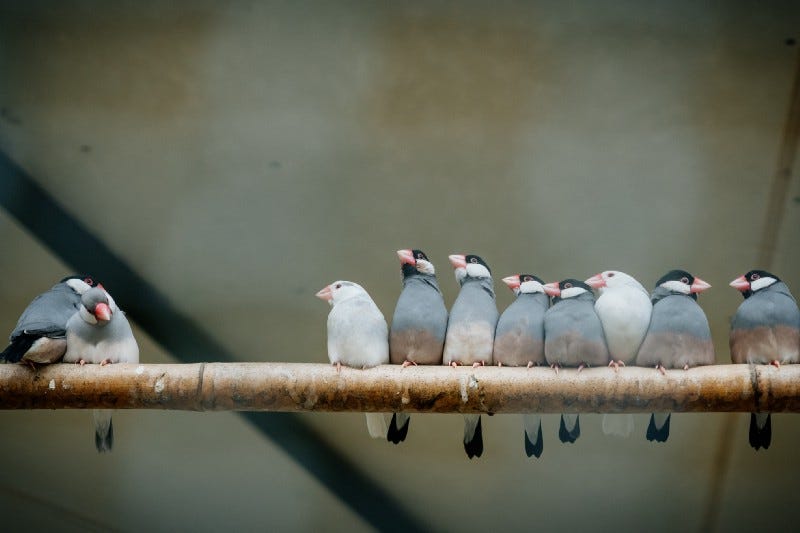
Photo by Pourya Gohari on Unsplash
While doing observation, we will try not to refer to ornithology as it might biased observational studies with already available information on the internet. Instead, we would simply observe the activities of birds.
Here, is the critical thinking of my observation :
How are they communicating with each other?
Does closely sitting together give them a feeling of warmth, and safety?
What could be the reason behind a group of two birds on the far left sitting at distance from other flocks of birds?
What could be the reason behind a group of two birds on the far left looking left-down and right-down whereas others look at the front, back, and up?
What conversation is going on between the group of two birds on the far right?
I hope you would have enjoyed this small observational study on a flock of birds. Here, the purpose is to observe the flock of birds “as it is” and think critically about each observation so that we can eliminate the scope of biased in our observational research studies. If we do the same observational studies in a live environment, then we could uncover invaluable insights from the same study we did earlier in this article.
In the end, I would say observational skills are the first milestone in the journey of UX research practices. The more we practice better we develop our understanding of our users’ attitudes in their environment.